

When the Water Runs Short, the Debt Runs Deep
The pipes arrived one spring. They were laid in neat rows across the fields, silver and promising. For farmers across Khorezm and Karakalpakstan — two regions that have watched the Aral Sea disappear across their lifetimes, it felt like an answer to something that had been getting worse for decades. The idea made sense. Water was running out. New technology could save it. A farmer borrowed from the bank, signed the contract, and waited for the harvest that would cover the cost. For many, that harvest never came.
A Land Under Pressure
To understand what is happening on Uzbekistan's farms today, you have to start with the ground itself. Khorezm and Karakalpakstan lie in the lower reaches of the Amu Darya river, in flat, poorly drained plains that have been irrigated for centuries. Over generations, salts have accumulated in the soil, a natural process that worsens when water tables are high and drainage is poor. Today, soil salinity is one of the defining agricultural challenges of both regions.
Climate change is tightening the pressure. Central Asia is warming faster than the global average. The Amu Darya, which sustains the farms and drinking water of millions, is expected to carry up to 15 percent less water by 2050 as glaciers in the Pamir and Tian Shan mountains retreat. Already, summers are longer and hotter. The March 2025 heatwave struck precisely when Uzbekistan's fruit trees were in flower, threatening yields across the country.
The Aral Sea, once the fourth-largest lake in the world and now largely a desert, is the most visible symbol of what prolonged water mismanagement looks like. Salt, dust, and pesticide residue from its dried bed still blow across adjacent farmland in Karakalpakstan. The region has the highest poverty rate in Uzbekistan, around 20 percent in 2022, and average monthly wages of roughly $306 — half what workers earn in Tashkent. Those who lose their agricultural livelihoods often leave for Russia or Kazakhstan, sending money home to families whose income depends on those remittances. This is the backdrop against which Uzbekistan's farmers are trying to adapt.
The government's response to the water crisis has been ambitious. President Mirziyoyev pledged to extend water-saving technology, primarily drip irrigation, across all 4.3 million hectares of Uzbekistan's irrigated farmland by 2030. By August 2024, roughly 304,000 hectares had been equipped. The state invested around $214 million in 2024 alone, with a further $100 million allocated for 2025. In May 2025, the World Bank approved an additional $200 million credit toward modernizing irrigation infrastructure in Karakalpakstan and four other regions.
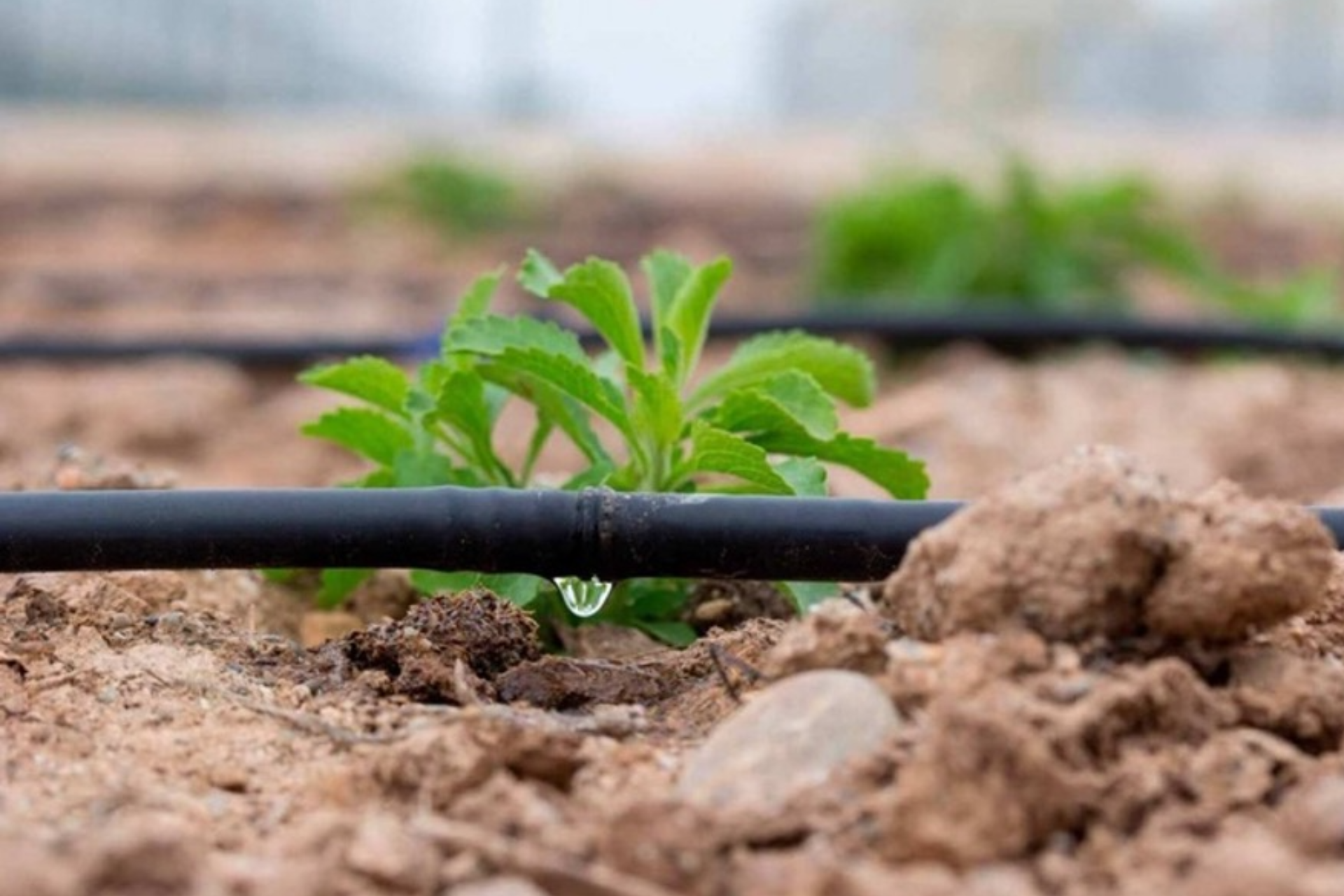
Drip irrigation, when it works, genuinely saves water. Rather than flooding entire fields, it delivers water directly to plant roots through a network of pipes and emitters, dramatically reducing losses to evaporation and runoff. In places with the right soil, the right crops, and reliable technical support, it has transformed agriculture.
But installing one hectare costs around 25 million Uzbek som, approximately, $2,200 at current rates. Government subsidies typically cover only about a third of that. The rest must come from farmers through bank loans. For someone farming twenty or thirty hectares, the debt runs into tens of thousands of dollars, to be repaid from harvests that, in these regions, are increasingly uncertain.
Where the Technology Meets the Soil
Here is the core difficulty that researchers and farmers have both identified: drip irrigation is not equally suited to all soils.
In Khorezm and Karakalpakstan, the soil is heavily salinised. Traditional flood irrigation, despite using large volumes of water, serves a crucial secondary function in these conditions, it flushes salt downward through the soil profile, keeping the root zone farmable. Leaching salts from the soil in the lower Amu Darya region requires roughly 25 to 30 percent of all water diverted for irrigation. It is wasteful, but it keeps the land alive.
Drip irrigation concentrates water in one spot. Without adequate drainage infrastructure, it can allow salts to accumulate around plant roots rather than flushing them away. The effect, on already saline soils, can be the opposite of what was intended.
Farmers in both regions describe the same result. They receive the equipment, connect the pipes — and then watch their crops struggle. Many continue irrigating by traditional methods, because their cotton and grain will not grow any other way. The pipes sit in the field; the debt sits in the bank.
Researchers who conducted extensive interviews with farmers and local officials across Uzbekistan in 2023 reached a clear conclusion: scaling up drip irrigation was encountering significant challenges due to regional differences in soil, water management, and farm size. They called for soil health assessments before systems are installed, and emphasised that farmers need genuine support and choice, not a technology imposed without adequate preparation of the underlying conditions.

The Debt Farmers Carry
The financial arithmetic is painful. A farmer takes a loan to install drip irrigation. The system does not perform as expected, either because of soil conditions, or because the installation was incomplete, or because the promised technical support never arrived. The harvest does not cover the loan repayment. Interest accumulates. The next season begins already in deficit.
In Amudarya district of Karakalpakstan, this cycle reached an extreme in 2024. Fourteen farmers signed contracts with a single firm for the installation of water-saving systems, taking loans from Agrobank to cover the cost. The firm received advance payments totalling around $340,000. Little or no work was completed. The farmers were left with individual debts of between $15,000 and $100,000, with no systems in the ground. The contractor was arrested in early 2025, tried, and sentenced in May to six years in prison. But the farmers' loans remained. Their fields were unchanged. The debt continued.
This case drew attention because it ended in a conviction, but farmers across both regions describe variations of the same experience: systems installed only partially, technical support that never materialised, loans that outlasted any benefit the equipment delivered. Dozens of similar complaints have circulated on farmers' Telegram channels in recent years. The underlying issue is not malice but a gap between the speed of a national rollout and the slower work of building the conditions — soil preparation, proper drainage, farmer training, reliable contractors, maintenance networks that make the technology function.
What Works, and What Could
In Karakalpakstan's Kegeyli district, a different story is unfolding. Farmer Atazhan Nurzhanov received support through a UNDP-backed climate resilience project to install an energy-efficient greenhouse equipped with a water-saving irrigation system suited to his actual conditions. The greenhouse now produces around five tonnes of cucumbers and other vegetables annually. His income has stabilized. The community has a reliable local food supply. "Previously, we were completely dependent on seasonal conditions," he said.
The difference between his experience and that of indebted farmers elsewhere is not the technology itself — it is the process around it. The greenhouse was matched to his soil and his crops. He received training and ongoing support. The decision was made with him, not for him.
Researchers point to several practical steps that could close the gap between policy ambition and farm-level reality. Soil salinity assessments before any system is installed would ensure that farmers in Khorezm and Karakalpakstan receive technologies suited to their actual conditions, which might mean improved drainage infrastructure before drip irrigation, or different water-saving approaches altogether. Subsidies that cover a larger share of installation costs would reduce the financial exposure of farmers who are already operating on thin margins. Longer loan repayment terms, aligned with the time it realistically takes for new systems to show results, would ease the pressure of the first difficult seasons. And investment in maintenance networks and farmer training, the unglamorous infrastructure behind any technology, would make systems last.
The World Bank's $200 million project approved in May 2025 includes concrete lining of primary canals and installation of water flow monitoring systems. These are upstream improvements that, if they reach farms in Khorezm and Karakalpakstan, could improve the baseline conditions that determine whether farm-level technology succeeds or fails.
The Season Ahead
In the fields of Khorezm, the pipes are still there. Farmers who borrowed to install them are entering another season carrying debt from the last one. The summers are getting hotter. The river is carrying less water every decade. The pressure to adapt is real and urgent and farmers know it better than anyone.
What they are asking for is not rescue from change. They have been adapting to difficult conditions for generations. What they are asking for is adaptation that fits their land, technology matched to their soil, support that arrives alongside the equipment, and loans that give them enough time to find out whether any of it works.
The water crisis in this part of Uzbekistan is not going away. But the farmers who live with it every season carry knowledge about their land that no national policy document contains. The solutions that last will be the ones built with them.
Dilobar Zaripova