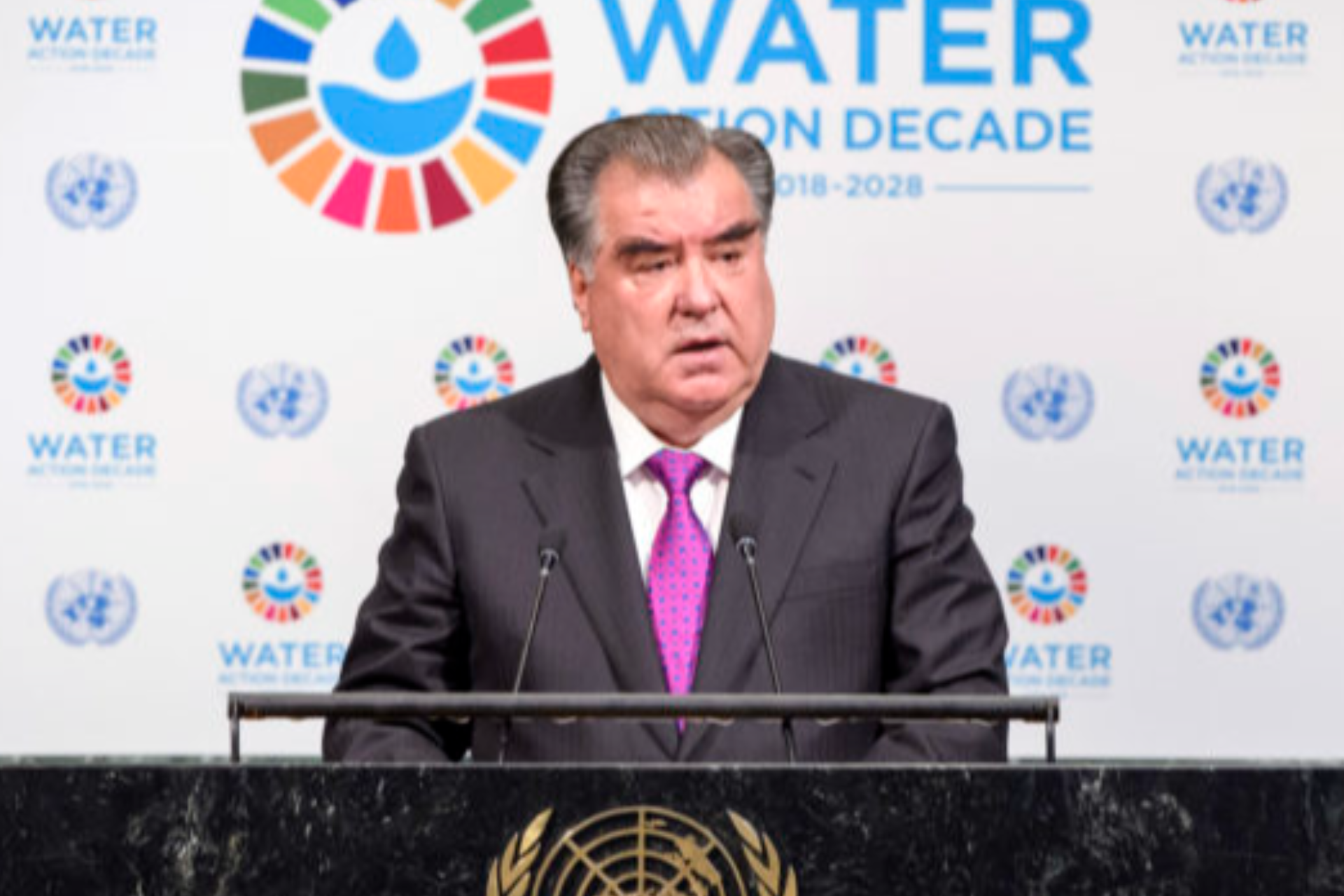
In the 21st century, providing the population with drinking water, protecting water and energy resources, and adapting to global climate change have become key and vital issues for humanity. Water is no longer solely a natural resource or an environmental element. It has transformed into a fundamental factor in national security, sustainable development, and geopolitical stability on a global scale. States and international organizations are searching for effective ways to address water crises, droughts, rapid melting of glaciers, and the inevitable consequences of climate change. In this context, the Republic of Tajikistan, under the leadership of the Founder of Peace and National Unity – Leader of the Nation, President of the Republic of Tajikistan, Emomali Rahmon, is recognized as a pioneering state and global leader on water and climate issues.
The signing of Decree No. 1184 of the President of the Republic of Tajikistan dated June 15, 2026, "On the Establishment of the International Prize of the President of the Republic of Tajikistan in the Field of Water Management" marks a new qualitative and logical stage in this consistent policy. This decree, signed on the basis of Article 69 of the Constitution of the Republic of Tajikistan, represents not only recognition of Tajikistan's achievements but also an effective tool for stimulating and mobilizing global scientific, political, and public forces to address water and climate issues. The decree has a solid legal and institutional framework, guaranteeing the seriousness and sustainability of this initiative. To fully understand the significance of the decree, a detailed analysis of its main provisions is necessary.
The decree was issued on the basis of Article 69 of the Constitution of the Republic of Tajikistan. This article regulates the President's powers to determine the main directions of the country's domestic and foreign policy, as well as to represent the state in international relations. The reference to this provision emphasizes that water policy is an integral and inseparable part of Tajikistan's state strategy and foreign policy.
The main objective of the decree is formulated as follows: "to stimulate and provide the highest recognition for outstanding contributions to the development of international cooperation, research, sustainable policy, and to addressing global water resources and climate change issues." This demonstrates Tajikistan's intention to create a platform where scientists, politicians, international organizations, and civil society activists will be recognized for their outstanding achievements in the water sector.
Clause 2 of the decree stipulates that the award will be funded from the state budget and other sources not prohibited by law. This aspect is of fundamental importance, as it demonstrates a high degree of state responsibility. The allocation of funds from the state budget confirms Tajikistan's commitment to devoting its own financial resources to supporting global water initiatives. The wording "other sources not prohibited by law" opens the possibility of attracting funds from international financial institutions, environmental funds, and donors, significantly enhancing the prize's international status.
Clause 3 of the decree instructs the Government of the Republic of Tajikistan to develop and approve the regulations and composition of the Prize Commission within two months. This demonstrates the government's commitment to the prompt practical implementation of the initiative and the development of a transparent, professional mechanism for evaluating candidates. The Commission will be comprised of reputable domestic and international scientists, as well as representatives of relevant international organizations.
[28.08.2026 21:23] Ilhomjon tajikistan Hamidiyon: To fully understand the significance of this prize, it is necessary to consider the history of the activities and personal contribution of the President of the Republic of Tajikistan, Emomali Rahmon, in this area. The head of state of Tajikistan is recognized internationally as the "Architect of Water Diplomacy" and "Global Water Leader." Over the past two decades, it was on the initiative of Emomali Rahmon that the UN General Assembly adopted a number of historic resolutions that shaped the global water agenda.
Tajikistan, under the leadership of Emomali Rahmon, put forward five large-scale global initiatives, unanimously supported by the international community:
1. International Year of Freshwater (2003).
2. International Decade for Action, "Water for Life," 2005–2015.
3. International Year of Water Cooperation (2013). 2. International Decade for Action, "Water for Life," 2005–2015
3. International Year of Water Cooperation (2013)
4. International Decade for Action, "Water for Sustainable Development," 2018–2028
5. International Year of Glacier Conservation (2025) and World Glacier Day.
These five initiatives demonstrate the continuous, strategic, and comprehensive nature of the policy of the President of Tajikistan. They have not remained mere political declarations but have transformed into practical global programs that contribute to improving the quality of life of millions of people across the planet.
Each initiative of the President of Tajikistan was put forward at a specific historical period in response to specific challenges.
Decade "Water for Life" (2005–2015). This decade laid the foundation for elevating water issues from the status of secondary issues to the center of global political attention. During this period, Tajikistan became a venue for high-level international conferences. It was then that the global community realized that without addressing water issues, it would be impossible to achieve socio-economic development goals.
The "Water for Sustainable Development" Decade (2018–2028) is focused on implementing UN Sustainable Development Goal 6 (ensuring availability and sustainable management of water and sanitation for all). As part of this decade, the Dushanbe Water Process was recognized as a key global political platform for assessing progress and identifying next steps.
The 2023 UN Water Conference in New York, co-chaired by Tajikistan and the Kingdom of the Netherlands, was a historic event and the first major UN conference on water in 46 years (since 1977). Emomali Rahmon served as a key leader at this conference, presenting the Water Action Agenda, which included over 700 commitments from states and organizations.
Glacier Conservation Initiative. Emomali Rahmon was one of the first to scientifically demonstrate, from the UN podium, the close and dangerous link between glacier melting and climate change. Tajikistan has thousands of glaciers, which form the main source of water for Central Asia. However, as a result of global warming, more than 1,000 of Tajikistan's glaciers have already completely melted.
The adoption of the UN resolution declaring 2025 the International Year of Glacier Conservation and the establishment of a Special Trust Fund at the UN was a major success for Tajik diplomacy. This demonstrated that Tajikistan was guided not only by national interests, but also by concern for the future of the entire region and the planet. The establishment of the International Prize of the President of the Republic of Tajikistan in Water Management represents a step of profound strategic and geopolitical significance. This prize has all the potential to become one of the most prestigious global awards in the field of ecology and sustainable environmental management.
Through this step, Tajikistan positions itself as an intellectual and political center for addressing global water issues. The prize immortalizes the name of the country's President, Emomali Rahmon, and Tajikistan in the history of global science and water policy. This prize has the potential to act as a powerful catalyst for scientists and innovators in their search for innovative solutions to the water crisis.
The prize will be an important diplomatic tool. It will create opportunities for prominent individuals, leaders of international organizations, and heads of state who have made significant contributions to the water sector to gather regularly in Dushanbe, thereby strengthening international cooperation and sharing best practices.
The signing of Decree No. 1184 on June 15, 2026, marks the beginning of a large-scale organizational and political process.
To ensure widespread recognition of the prize, a comprehensive information campaign is necessary. Presentation of the prize at UN events, international water conferences, and in leading global media outlets (such as the BBC, CNN, and Reuters) will attract the attention of key scientists and government officials. Thus, the Decree of the President of the Republic of Tajikistan, His Excellency Emomali Rahmon, establishing the "International Prize of the President of the Republic of Tajikistan in Water Management" is a far-sighted and timely step that further strengthens our country's status as a recognized global leader in this area.
Tajikistan's contribution to the water sector is historic and unprecedented. Our country has demonstrated that even a small country, with political will and visionary leadership, can transform the global political agenda and unite humanity around the supreme goal of preserving water and life.
The establishment of this prize represents not only recognition of the past and current achievements of Tajikistan and its esteemed leader, but also a strategic vision for the future. It is a tool to encourage future generations of scientists and politicians to take proactive action to protect our planet, combat climate change, and ensure peace and stability through water and resource cooperation. With this step, Tajikistan has once again proven that "Water for Life" and "Water for Sustainable Development" are not just slogans, but the historic mission of the state and its leader.
In this context, I would like to particularly emphasize one more detail. It is gratifying that, as part of a partnership between the faculty and staff of our university, in May 2026, an open lesson was held with the editor-in-chief of ekolog.uz, a recognized expert on environmental issues, Professor Nargis Sunnatovna Kasymova, and students majoring in international journalism. This was a very useful and productive experience. We look forward to further cooperation and the establishment of new bridges and horizons.
In a few days, our country will celebrate the 35th anniversary of its state independence. The passage of more than three decades since the Republic of Tajikistan gained its independence marks a period of creation and development of sovereign statehood. Independence is not just a source of pride or patriotic rhetoric, but a systematic process of struggle and hard work aimed at creating a solid economic foundation, protecting democratic values, and ensuring a decent standard of living for every citizen. These years have witnessed the implementation of large-scale communications and energy projects. The construction of highway tunnels, international bridges, and the reconstruction of railways and internal highways have led the country out of its communications impasse, transforming it into a unified transit area. At the same time, mutually beneficial ties with foreign countries and influential international financial institutions have expanded, creating a solid foundation for macroeconomic development.
Today, leaders and officials of all structures must faithfully serve the people and make the will of the citizens the foundation of their actions, as the people are the bulwark of society's hope. An analysis of the complex situation in the modern world, including political transformations in neighboring states, clearly demonstrates that without maintaining internal stability, national unity, and political vigilance, no society can defend its sovereignty in the face of geopolitical pressure.
The people of Tajikistan, possessing a deep historical self-awareness and expressing gratitude for the tireless efforts of the Leader of the Nation, are strengthening their unity around this leader and will continue to steadfastly strive to preserve the greatest blessing—Independence. HAMIDIYON I.I., Doctor of Philological Sciences, Professor at the International University of Tourism and Entrepreneurship of Tajikistan


Water|331
35 YEARS OF INDEPENDENCE. THE HISTORIC ROLE OF TAJIKISTAN AND THE LEADER OF THE NATION IN GLOBAL WATER DIPLOMACY
on the margins of the Decree of the President of the Republic of Tajikistan dated June 15, 2026, No. 1184 "On the establishment of the International Prize of the President of the Republic of Tajikistan in the field of water management"