

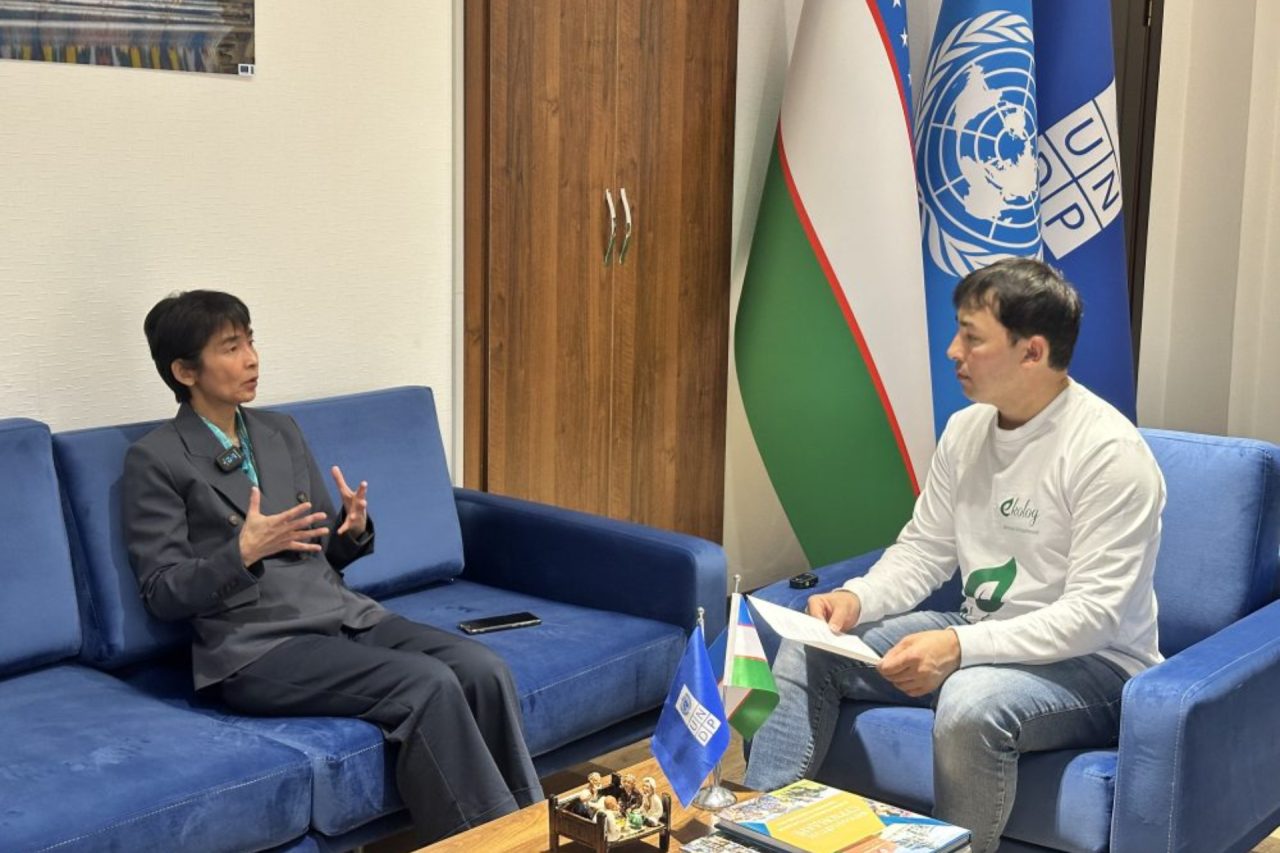
Our guest was Ms. Akiko Fuji, the new Resident Representative of the United Nations Development Programme in Uzbekistan. Ms. Fuji, who has 25 years of experience in the UNDP system, has held numerous leadership positions. Before starting her work in Uzbekistan, she served as Deputy Resident Representative in the Maldives, Vietnam, Fiji and Jamaica.
A staunch advocate for the United Nations Sustainable Development Goals, Ms. Fuji has played a key role in addressing the economic and social challenges of climate change. She has led large-scale humanitarian assistance in crisis and conflict situations, and has consistently provided strategic guidance on governance systems to ensure equitable and sustainable development.
Ms. Fuji holds master's degrees in gender and development from the University of Sussex, UK, and human and environmental studies from Kyoto University, Japan.
- In recent years, we have seen a significant increase in international organizations' efforts to cooperate with Central Asia in the political, economic, social, and environmental spheres, especially in environmental programs. How do you see the prospects for cooperation between UNDP and other international organizations with Uzbekistan in this area?
-Thank you for inviting me to a conversation on an important topic! You are right, there is a growing awareness among the population about the problems, difficulties and natural phenomena that are occurring. We see that each country is affected differently by climate change, depending on its specific geographical, economic and social situation.
When it comes to Central Asia, it is true that scientists are already predicting more frequent extreme weather events such as heat waves, floods, and mudslides in some places, and more frequent water shortages in others. These are some of the symptoms and impacts of global climate change in this region. This in itself means that it is necessary to protect the lives of the people living in this region and adapt them to the changes that are taking place. That is why the government of Uzbekistan, while strengthening its policies in this direction, has set itself the goal of implementing a policy that meets the needs of the people. International organizations such as UNDP, in turn, are putting forward their proposals to help effectively implement these goals, and we have various proposals to support these initiatives.
-Can you share with us the work your organization is doing to address environmental issues in Uzbekistan?
-For the UNSDGs, the principles of sustainability and equity are very important in solving problems on a global scale. Because when we talk about sustainable development goals, we need to cover not only environmental sustainability, but also, as I mentioned above, the socio-economic, geographically diverse conditions of people, climate change and natural disasters, their different impacts depending on the different status of their location. Taking these aspects into account, together with the government of Uzbekistan, we are trying to link the SDGs' environmental, poverty and climate change goals and consider them holistically.
- Could you share with us the work your organization is doing to address environmental issues in Uzbekistan?
-For the UNSDGs, the principles of sustainability and equity are very important in solving problems on a global scale. Because when we talk about sustainable development goals, we need to cover not only environmental sustainability, but also, as I mentioned above, the socio-economic, geographically diverse conditions of people, climate change and natural disasters, their different impacts depending on the different status of their location. Taking these aspects into account, together with the government of Uzbekistan, we are trying to link the SDGs' environmental, poverty and climate change goals and consider them holistically.
That is, we cannot separate the problem of poverty from the impact of climate change. For example, our report “Multidimensional Poverty” that we prepared together with the government last year was carried out for the first time in Uzbekistan, but our organization has been using this methodology in different countries of the world for a long time. 13 different types of indicators showed the connection between climate change and poverty in different regions of the republic. For example, in some regions, certain environmental risks are stronger due to the lack of sufficient funds and opportunities to solve the problems. For example, the heating system. In Kashkadarya, 75 percent of schools still burn coal because they do not have modern heating systems. This, of course, has a negative impact on the quality of education for children. This situation may also hinder your country's goal of reducing greenhouse gas emissions by 35% compared to 2010 levels.
You see, you can't solve the problems of poverty, the environment, and decarbonization without addressing them separately.
- How is UNDP supporting Uzbekistan's "Green Economy 2030" program? Personally, are you observing any positive results?
-Of course. Just one example. The "Green Space" initiative. Every year, the UN, UNDP and other international organizations actively participate in this greening event. The amazing thing about this work is that by mobilizing a wide community, the government of Uzbekistan is solving not only national but also global problems.
For example, let's take this year's three COP international conferences: Azerbaijan, Colombia, and Saudi Arabia, where the fight against desertification is aimed at solving global problems. I think the national campaign by the government of Uzbekistan to establish afforestation on degraded lands, together with local communities, is one of the positive examples of improving the livelihoods of people in areas where desertification is severe, such as the Aral Sea.
I could probably list many more innovative initiatives. For example, the SDGs and green bonds issued with the support of UNDP. These are securities, financial resources that help meet the needs of the people. These bonds, equivalent to 200 million US dollars, were seen as the first innovative sustainable finance initiative in the region.
This is a truly innovative approach. It is crucial to make the funds transparent to ensure that the private sector and sovereign wealth funds are channeled where they are needed most. The BRM bonds will be used to support projects that shift from conventional to green transport. One of these is to promote public transport by increasing the number of metro stations in Tashkent. This is being implemented in projects that promote the use of public transport, which will increase people's mobility and replace private vehicles with environmentally harmful ones.
The Multidimensional Poverty Report will help to increase investor confidence and spur more innovative ideas for green finance. We have also accelerated our work with Uzbekistan on the transition from a traditional economy to a green economy. That is, given that the decarbonization process will affect certain industries and jobs, we are also working to ensure that they adapt to the new green reality.
Young people need to know the new skills and abilities that will be needed in the future. The current traditional industry may be completely different from the green economy that will be created in the future and may become irrelevant. The program also pays great attention to the fact that people in the process of transition to this green economy will acquire highly qualified skills, to acquire new types of green economy. We are talking about people's lives, aren't we?! We are talking about the situation where the professions they currently hold may disappear, about the owners of professions who will need to be retrained for various types of green industry.
This is why one of the priorities that the United Nations and UNDP, together with the Government of Uzbekistan, are focusing on is raising public awareness, strengthening the regulatory framework, and enabling people to transition to a fair green economy without loss.
- How do you see the role of the media and civil society in solving environmental problems?
- I think that in this era of digitalization, access to information, debates about the opinions expressed by people have become more democratized. Everyone is increasingly able to post the type of information they want on social media. But at the same time, we are jeopardizing some of the fundamental principles of information dissemination and education, in a sense, through the media, because there are no editors. On the other hand, artificial intelligence is manipulating information in many ways that we do not notice.
This requires thoughtful, responsible actions. In particular, the role of media representatives in providing factual information is extremely important. In this regard, it is necessary for eco-journalists like you, for example, to adhere to ethical standards. I would also like to emphasize that the role of media and civil society is becoming increasingly important in the current era.
Thank you for the informative conversation!
Avazkhon Khaydarov