

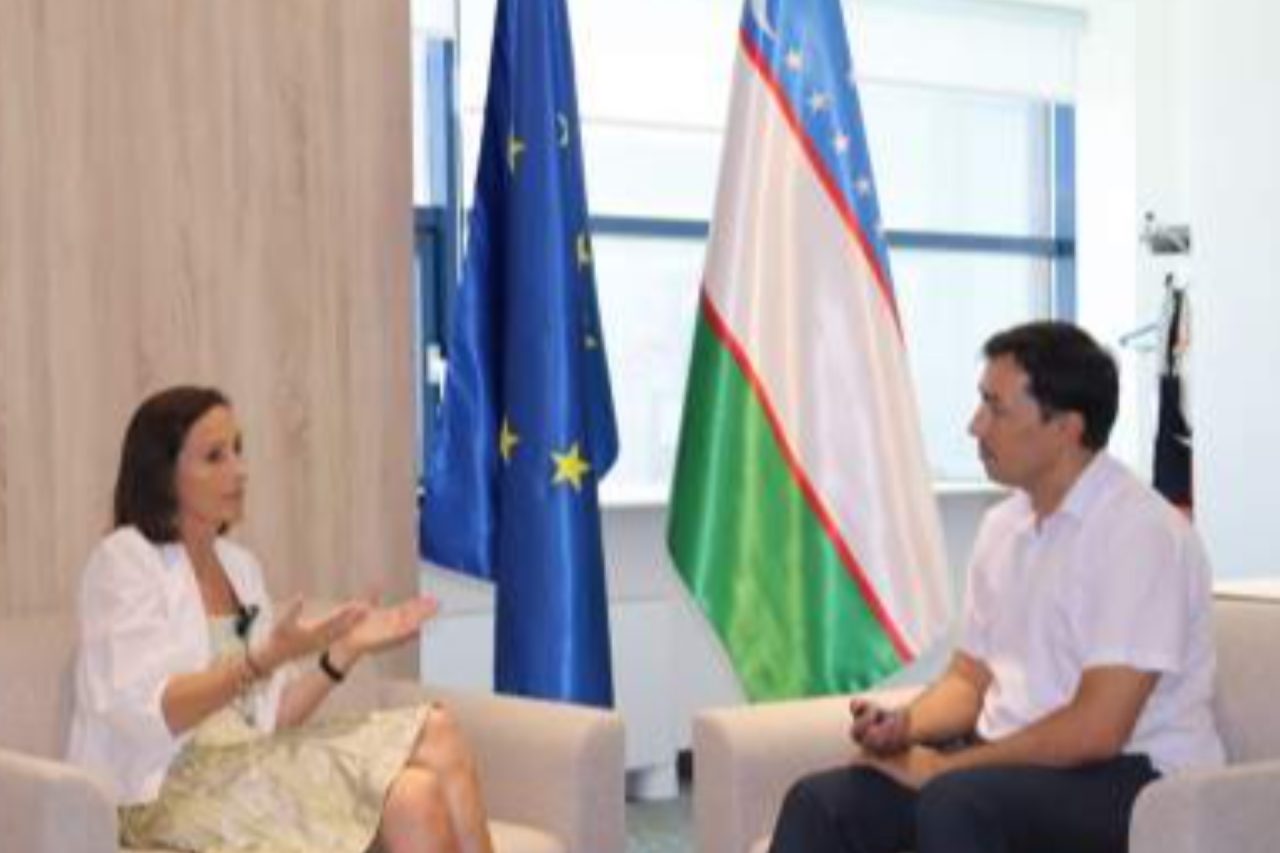
Today’s guest on Ekolog.uz is Her Excellency, Charlotte Adriaen, the Ambassador of the European Union to Uzbekistan. The renowned diplomat spoke about the increasingly scarce water resources in Central Asia and introduced the EU’s efforts aimed at saving and managing water wisely.
Greetings, Your Excellency!
Unfortunately, it is no secret that the Aral Sea tragedy forced the population living around this basin to abandon their homes and triggered forced migration. What work is currently being done by local and international organizations — particularly the European Union — to address these issues?
Good afternoon!
I am very pleased to have this opportunity to speak with you about the Aral Sea tragedy and other environmental problems in the region. Our organization considers the Aral Sea disaster one of the most important international issues and evaluates it as a regional problem. The EU has always supported various environmental projects in the Aral Sea basin financially and closely monitors how countries manage their water resources. A recent example is the international conference held in Dushanbe, Tajikistan, dedicated to the 30th anniversary of the International Fund for Saving the Aral Sea (IFAS), titled “Towards Sustainability through a Strong Regional Institution in Central Asia.”
It must be emphasized once again that the Aral Sea tragedy is not only Uzbekistan’s problem — it is a pressing issue for all Central Asian states. Here, I also refer to Afghanistan’s Qosh-Tepa Canal, as this country is becoming one of the region’s major water consumers. Understanding how critical these developments are, the EU continues to analyze ways it can contribute. As you noted, these environmental changes also have a direct impact on economic migration. Agriculture is one of the main economic drivers in your country, and industry is also developing. The rapid use of water in these sectors naturally affects climate change. Now, to your question about what projects the EU is implementing in Uzbekistan…
One example is WECOOP (EU–Central Asia Cooperation on Water, Environment, and Climate Change). The project aims to strengthen political dialogue among Central Asian countries on sustainable development and support their cooperation with the EU on environmental and climate-related issues.
Another initiative is the National Water Policy Dialogue (NPD) on Integrated Water Resources Management. This platform discusses achievements, problems, priority areas, safe and fair water supply, sanitation, and transboundary cooperation in Uzbekistan’s water policy.
As you mentioned, the transition to a Green Economy should not be forgotten either — especially the introduction of water-saving technologies in agriculture. For example, cotton or rice cultivation. These crops require large amounts of water, and given climate change, we recommend switching to less water-intensive crops. This remains a key direction in our dialogue platforms.
In fact, these problems are becoming increasingly relevant in Europe as well: drinking water shortages, droughts, the abandonment of certain crops, and food security. These are issues we must solve together.
Why is the development of irrigation systems in Uzbekistan important for the European Union?
Let’s go back a little. Before 2017, our projects in Uzbekistan were limited to agriculture and very specific directions within it. After Uzbekistan’s new president accelerated reforms, new opportunities for cooperation emerged. Uzbek farmers began working with a new approach. This means moving away from a centralized planned economy and gaining freedom to grow crops they choose. And in times of severe water scarcity, doesn’t this make the development of irrigation systems and efficient water use even more important?
We must admit: water is decreasing, while the population is growing. We now hear discussions about delegating water resource management to the private sector, introducing innovative technologies, and moving toward real market-based pricing — as is done in Europe. This means that water has become a topic of urgent discussion for all of us. After all, water is a priceless blessing — and it is time to value and cherish it like gold.
Then here is my next question. Does Europe need agricultural products from Uzbekistan, or does it genuinely want to help this country?
This is a very interesting question — I like it! (laughs).
You know, Europe is not made up of one individual or one community. As a unified Union, we intend to further strengthen multi-dimensional cooperation with Uzbekistan. For example, economic cooperation. More than 6,000 products can enter the European market under GSP+, a special preferential trade regime — including agricultural goods. Uzbek fruits and vegetables spark great interest among European entrepreneurs. On the other hand, member states of the GSP+ system are required to adhere to human and labor rights, environmental and climate protection, and good governance standards. Thus, this cooperation serves the interests of all parties — you, me, our children, all of us.
Our Development Cooperation Program also supports economic, social, and political projects aimed at reducing poverty in both Uzbekistan and the EU. This directly contributes to achieving the UN Sustainable Development Goals. The efforts of President Shavkat Mirziyoyev in this direction clearly demonstrate progress, and the EU is ready to support and further strengthen this cooperation.
A clear example of our joint fight against poverty is the “Fergana Valley Water Resources Management – Phase II (Component B)” project, supported by Uzbekistan, the EU, and the World Bank under the grant “Support to Agricultural Intensification, Diversification, and Improvement of Water Management.” Through expanding employment opportunities in horticulture, we chose the most densely populated region to demonstrate that efficient use of resources can lead to significant results.
We are also involved in improving the Agricultural Knowledge and Innovation System (AKIS) in Uzbekistan. Although such work may not always be visible, farmers and growers can access this database to learn about new water-saving technologies.
I believe that our cooperation in agriculture will lead to the positive outcomes we all hope for.
Thank you very much for this meaningful conversation!
Interview by Avazkhon Khaydarov