

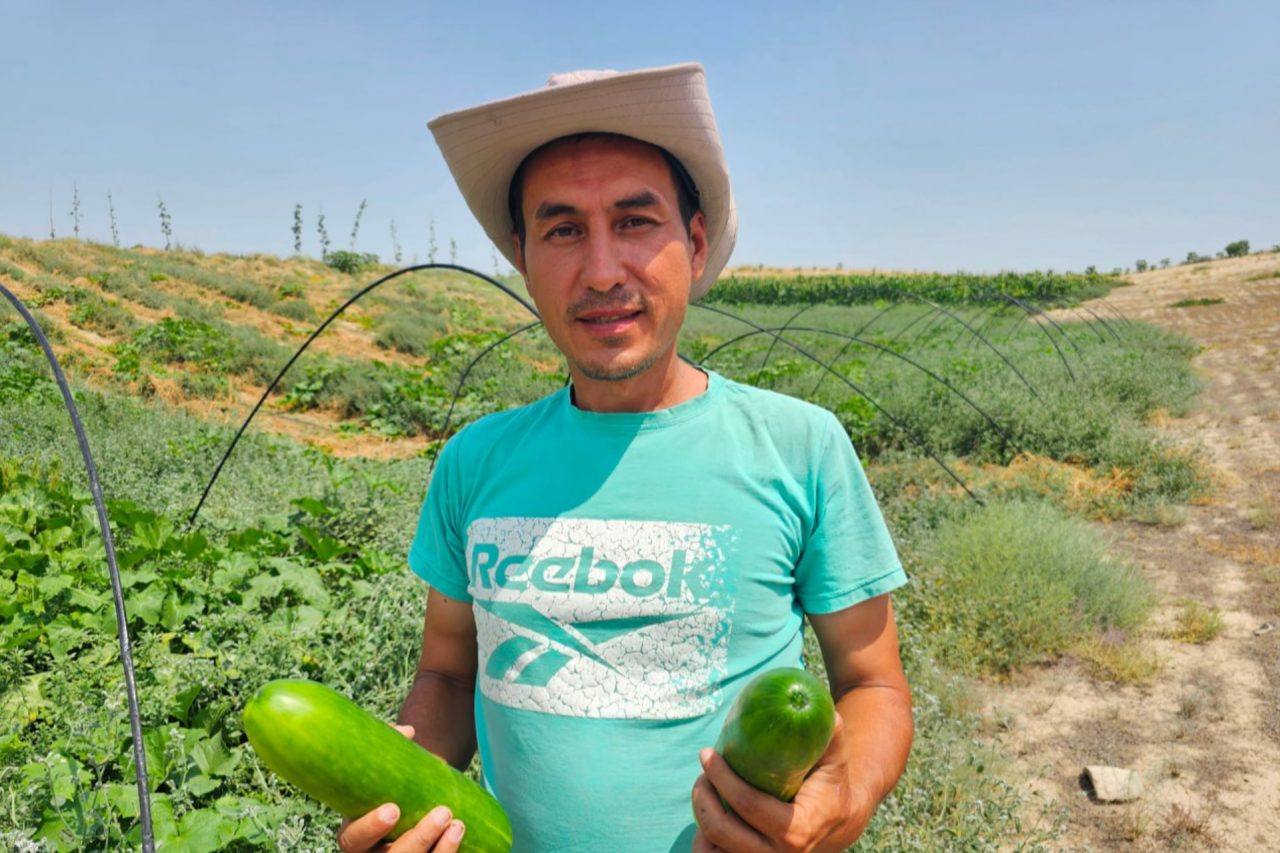
Love for nature and the desire to serve humanity sometimes inspire great ideas. A vivid example of this is the amazing efforts of a young man who dedicated his life to preserving the environment in one of the most arid regions of Uzbekistan. The correspondent of www.ekolog.uz interviewed Otabek Nuritdinov, who came up with such a noble initiative as creating a forest in the 220-hectare area of the hilly area, which until now has not been touched by humans, in the “Ergashobod” MFY, “Sohibkor” massif, Asaka district of Andijan region.
- Why did you have the idea to create a forest in the hills? Is it a passionate love for nature for you or just a desire to take risks?
- Every person should have a purpose in life, first of all. In addition, every person should leave behind some good mark for the next generation. You know, millions of people come and go in the world, buy houses, cars, accumulate wealth. Do all of them leave behind a good mark that is not only beneficial to themselves, but also to society? This is something that has been on my mind since my youth.
In short, I also want to leave something behind in this fleeting world. Anyone who sees these places thinks that it is impossible to create a forest in such a place. People still look at this as a fantastic idea that cannot be realized. But our ecology is getting worse every year. UN Secretary-General Antonio Guterres, standing from the UN rostrum and reading the written texts of world scientists, said that the countries facing the most serious environmental problems are the countries of Central Asia. Our President has also spoken a lot about this urgent problem.
Unfortunately, most of us have learned to live only for today. I have thought about this in every way and have set myself a noble goal to do something useful for both our people and our ecology.
Today, our compatriots are really thirsty to get out into nature and relax. Real natural landscapes, especially when there is snow, are becoming a "legend". How much snow fell when we were young. We never got tired of snowstorms and sledding, but what about today?! It would not be an exaggeration to say that today's generation is growing up without seeing snow. Parents who have some opportunity to show their children snow take their children to the mountains in winter.
- You posted on your social media page that you were exempt from taxes for five years. Are you really exempt from taxes?
- There are no regulatory documents in our legislation that support such initiatives. This certainly discourages people like me who are committed to a great goal. I think that the officials of the higher law-making bodies should think about this more deeply and adopt regulatory and preferential documents for people like us. The reason is that in some countries, for example, in Germany, forests are considered private and the state provides them with special subsidies and benefits. They do not have any difficulties in running private forestry. Because, as a result of the support of this work by the state, they can easily implement their reforms in this regard.
We need state support in developing undeveloped lands. The lands I chose were not even in the database. You can't just plant seedlings on the land yourself, of course, you have to do the paperwork first. We said we were acting legally, but when we went to formalize the paperwork, they said the land acquisition procedure would be carried out only through an auction. To put it up for auction, we put the hill up in the database, put it up for auction, and bought the land through an auction.
The land purchased at the auction will become arable land for which taxes are paid directly. My mother will be more involved in the paperwork, while we will be busy with the arable land in the hills. We wanted to buy the land not for gardening, but for forestry, but there is no mention of forestry in any regulatory document. We applied to several organizations in Tashkent. They agreed and confirmed that this land is actually a dry hilly area.
Unfortunately, the areas intended for forestry have become horticulture. So far, we have been doing all the work we can, within our means, at the expense of our own funds. Some of our compatriots have been supporting our idea through social networks, writing their opinions and transferring funds to our card numbers, albeit small amounts, as assistance. True, although these funds do not constitute large sums, they are helping to solve some small problem in the work we have started today. As they say, "Give strength to the roper, and strength to the roper," we are grateful to our compatriots who support us.
We have a five-year tax exemption for the land we want to establish a forestry business, 220 hectares of land. We are now thinking about what we will do during the year of the exemption and after these five years. If there are financial difficulties, we will have to take a certain part of the land and return the rest to the state. If we also want to implement our plans such as purchasing equipment, establishing greenhouses and water reservoirs, this will require even more patience and perseverance from us, and there will be an opportunity to develop "grey" lands.
- If our state grants you another grace period exempt from additional taxes, will you continue your work on forest establishment?
- When organizing a forest, I need not only the privilege of exemption from tax payments, but also the financial means to carry out this work. Because we need machinery and labor in the hills. In addition, water needs to be brought to areas where water networks are not available. Now I need a greenhouse to grow seedlings in order to plant seedlings in the forest, and a water reservoir to ensure constant irrigation of the seedlings. The problem of labor can be solved with the help of volunteers and those who support the good work I have started. By water reservoir, I mean a reservoir that can supply water not only for the 220 hectares of hills, but also for the surrounding lands.
When I saw images of the Korean state in the 1950s, the Japanese cut down the forests of Korea after World War II. After these events, the land began to degrade. Groundwater ran out, precipitation decreased. It fell into the same situation as ours. After that, in 1957, the head of state at that time signed a document on the establishment of forestry and took appropriate measures. At that time, Korea was not a developed, stable state, there was no technology. But their greatest achievement was the unity of the people. They made huge plantations and made forests. If you go now, you will envy them.
-As you said above, water is very important for seedlings. Where does the water come from in Adirlik?
- We have pumping stations down there, and we mainly get water from them. We have one pumping station, two pumping stations. The pumping stations pump water into troughs left over from the former Soviet era, and then the water travels three and a half kilometers from the trough to our network. In the future, we have planned to use a polyethylene network to make this three and a half kilometer network. There is a reason for this, because many of our people still do not understand how much of a problem water is becoming. They are changing the water supply networks just to get a little fodder for their livestock. Three pumps pump water into the hill. The monthly limit for one pump is one billion two hundred million soums. This money is paid from the state. The state pays for what, it pays for people to plant gardens and seedlings. However, some people are using it incorrectly. In short, the water that comes to me is being stolen by "pirates" on the way. As long as we build a water supply there, there won't be any problems.
-What types of trees have you planted in your forestry so far?
-We planted tree seedlings such as elm and albizia, and in most areas, we planted our own paulownia seedlings. Despite the problem with water, the elm and albizia seedlings grew well. We also propagated the paulownia tree from cuttings. Our compatriots from Poland, America, Turkey and other countries are sending seeds. Some seeds have not yet adapted to our climate.
It is not possible to sow seeds sent from abroad in the open. First, we can build a greenhouse, multiply the seeds there, and then plant them in open fields. If we build and operate a greenhouse, we can nurture, grow, and multiply the seeds there, and then plant them in open fields.
-We know that you are not alone in the mountains, snakes, foxes, birds, and even gray goats, which are listed in the "Red Book" of Uzbekistan, visit the forest. What is your attitude towards these animals?
-As you said, there are rare animals around us. There have been several cases of gray goats falling into our ponds. We released them into the open. At first, the idea of breeding them arose. But I found out that they do not breed in captivity. Then, thinking that it would be better if they bred in the mountains, we released them without killing any animals that came along. Since I live in the city, it gives me pleasure to see such animals in the open. In fact, these places are their homes, and we live with them in mutual understanding.
-Who installed the solar panels on the hill? Was it sponsored or did you use your own funds?
-All the work done to install solar panels worth 75 million soums was carried out entirely at our own expense. We only have a small debt. If we are lucky, we will pay off these debts in the near future. At every step we take, we encounter one problem, and when we overcome one problem, we encounter another. The biggest problem right now is the organization of the water network and the need to connect the pipelines to all the taps.
- Organizing a forest is not just about human labor. What kind of equipment do you need?
-You are right, it is difficult to do all the work manually. We need at least a mini-tractor. I myself saw a mini-tractor of the Lovol 504 model, and the price was reasonable. At the same time, we also need a mini-excavator for our work in the fields.
-The regional governor is aware of the fact that you are organizing a forest, of course. What kind of help have they provided you?
-The help from the regional governor has been great. There has been constant support from the beginning. When we had problems with documents, we always went to the regional governor and resolved them. Now he is not aware of the current problematic situations, because it is embarrassing to take all problems to the regional governor.
In fact, there are organizations responsible for the work I do, but they hardly help me. For example, I have never heard of the Eco-Party. The existence of such a party came to my mind during my conversation with you. Not a single organization responsible for this area has come to me and said, "Brother, there is such a subsidy for drip irrigation, there is such a privilege for forestry, use it." In my mind, it's as if they were looking at me from the sidelines and saying, "Come on, where will Otabek go?"
-Recently, the governor of Asaka district visited the forest you are organizing and said that we will solve the water problem. Will these words just remain on paper?
-They owed us 55 million for the seedlings we delivered to the Asaka district administration. This money was not growing, but I explained it correctly to the district administration, and now there is a budget deficit. He said we will help from the next quarter. The guys left 2 pumps, saying that they will help with the pumps until then. Now we need to get 200 meters of cable and additional pipes for the reservoirs. If we fix the water network and lay the pipelines, we can prepare 10-15 hectares of land in the fall season.
-There are enough people who want to contribute by planting saplings in the forest. Can they also visit the forest and plant saplings?
-Of course it is possible. Anyone can join us and contribute to the creation of a forest. We will be happy to do so. This project is aimed not only at restoring the natural environment, but also at creating a sustainable living environment for future generations. We also want everyone to learn about our efforts and pay attention to this major project that is being carried out for the future of our country.
Nargis Kasimova
Feruzbek SAYFULLAYEV