

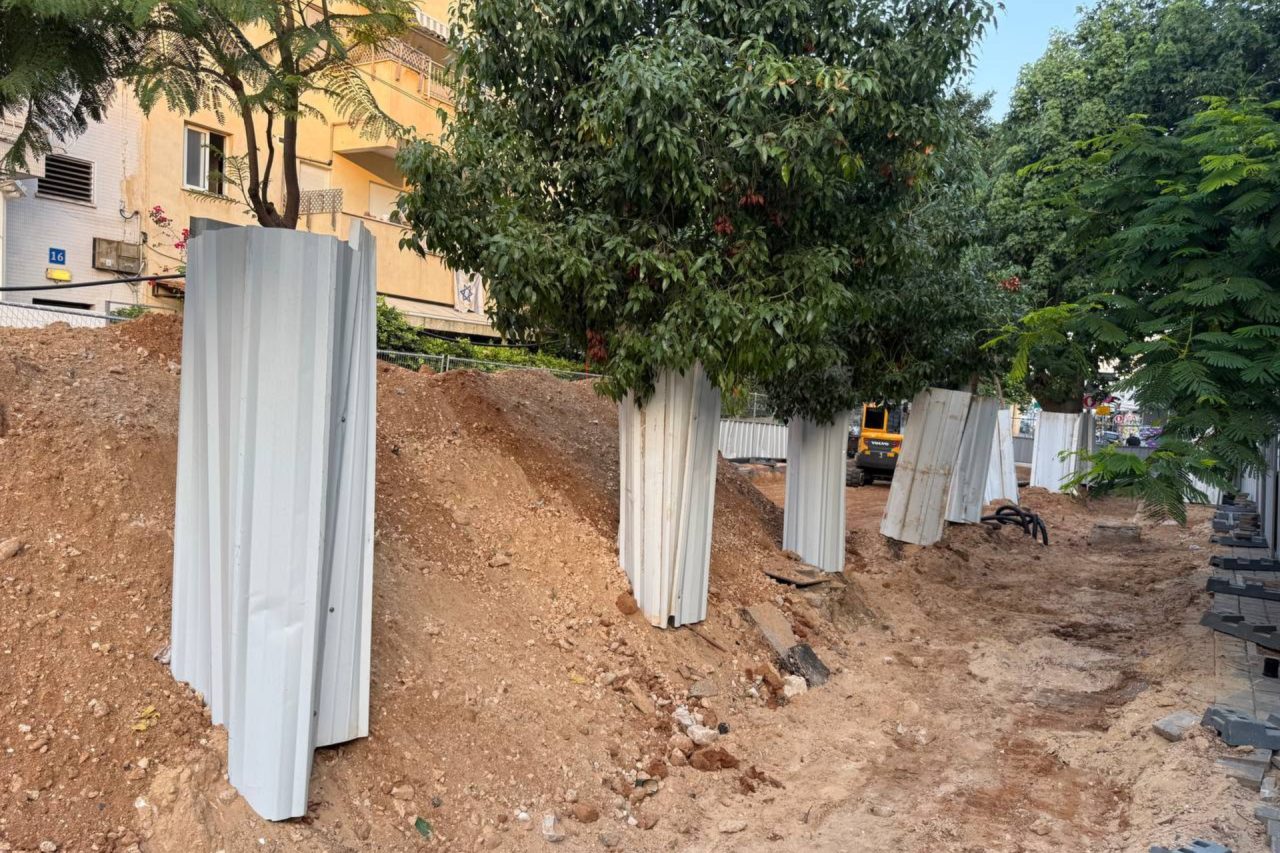
During my trip to Tel Aviv–Yafo, one particular aspect caught my attention. In areas where road construction and other infrastructure works were taking place, trees were given special protection. I also noticed that some residents who were renovating their homes were taking measures to protect the trees located in front of their properties from potential damage.
This made me interested in how Israel regulates the damaging and cutting down of trees.
A municipality is a local government authority responsible for managing a city. The Tel Aviv–Yafo Municipality pays serious attention to the maintenance and preservation of urban trees, as well as preventing their damage and unauthorized removal.
Trees Are Protected Even During Construction
When reviewing construction and development projects, the Tel Aviv–Yafo Municipality first examines all possible options for preserving existing trees. If a tree can be preserved, it is protected within the framework of the project according to specific requirements. Such work is carried out under the supervision of relevant specialists, including an agronomist.
This approach also made me think about some construction practices in Uzbekistan. Unfortunately, in some cases, instead of looking for ways to preserve trees at construction sites, there is an attempt to remove them as quickly as possible or plans are made in advance to cut them down.
So, can you simply cut down a tree in Israel?
No.
Under Israeli law, cutting down a protected or mature tree without the appropriate permit is prohibited. According to official government information, unauthorized tree cutting constitutes a criminal offense. The Tel Aviv–Yafo Municipality also requires official permission to be obtained before a tree can be cut down.
In addition, damaging trees during construction activities is prohibited.
Thousands of Shekels in Fines for a Single Tree
According to information from the professional research and analysis center of the Israeli Knesset, a person who illegally cuts down or damages a tree may face a fine of 7,500 shekels, while a business may face a fine of 15,000 shekels.
Depending on the circumstances, criminal proceedings may also be initiated and other penalties may apply.
Importantly, such a fine may be imposed for each individual tree.
When converted into Uzbek soums, 7,500 shekels is approximately 29.2 million soums, while 15,000 shekels is about 58.4 million soums.
In other words, illegally cutting down or damaging a single tree in Israel can cost an individual approximately 30 million soums, while a business could face a fine of nearly 60 million soums.
Such substantial fines clearly demonstrate how important trees are considered to be for the urban environment.
A Building Permit Does Not Automatically Grant the Right to Cut Down a Tree
There is another important point: a building permit itself does not automatically give someone the right to cut down a tree.
If a construction project requires a tree to be cut down or transplanted, a separate procedure applies. The relevant permission must be obtained through an authorized Forest Officer.
Trees are also protected on private property. In other words, even if a tree stands in a private yard or on a privately owned construction site, the owner cannot simply cut it down or damage it at will.
This approach is based on the understanding that a tree is not merely an object located on a particular property, but an important environmental asset that has value for the entire city and society.
Trees Are Considered Separately During the Approval of Construction Projects in Tel Aviv
During the building permit process in Tel Aviv, trees are given separate consideration.
The city licensing department’s “Gardens and Landscape” division reviews trees located on the construction site and in the surrounding area, as well as the need to transplant or remove trees and the measures required to protect existing trees during construction.
Under Israel’s forestry legislation, many tree species are protected. According to official government information, 68 tree species are protected.
If it is necessary to cut down or transplant a tree, the relevant permission must be granted by an authorized Forest Officer.
How Is the Loss of a Cut Tree Compensated?
Another important aspect of the Israeli approach is the compensation mechanism.
According to government information, if permission is granted to cut down a tree, the project owner must plant trees equivalent in volume and quality to the value of the tree that was removed.
In other words, the principle is not simply “one tree was cut down, so one tree must be planted.” The goal is to compensate, as far as possible, for the ecological value of the lost tree.
This is particularly important because the ecological value of a mature tree and that of a newly planted sapling are not comparable. A mature tree takes years, and sometimes decades, to reach its full size. During that time, it helps clean the air, provides shade, reduces urban temperatures, captures dust and provides habitat for various forms of wildlife.
A Tree Is More Than Just Greenery
According to some publications, approximately 150,000 trees are located in public spaces across Tel Aviv. A similar number of trees reportedly grow on private properties.
The city views trees not simply as decorative elements that make streets greener, but as an important part of urban infrastructure.
Especially in the context of climate change, increasingly frequent heatwaves and rising temperatures in cities, the importance of trees is becoming even more apparent. They provide shade, contribute to cleaner air, help reduce the urban heat island effect and improve the quality of the urban environment.
The most important lesson from Tel Aviv’s approach is that cutting down a tree should not be treated as a simple technical issue arising during construction.
All possible options for preserving the tree should be considered first. Only when removal is genuinely necessary should the relevant permission be obtained, and the ecological value of the lost tree should be compensated.
In my opinion, Uzbekistan should also pay greater attention to this principle when implementing construction and infrastructure projects.
Because cutting down a tree is easy. But growing another tree of the same size, health and ecological value in its place can take years — and sometimes decades.