

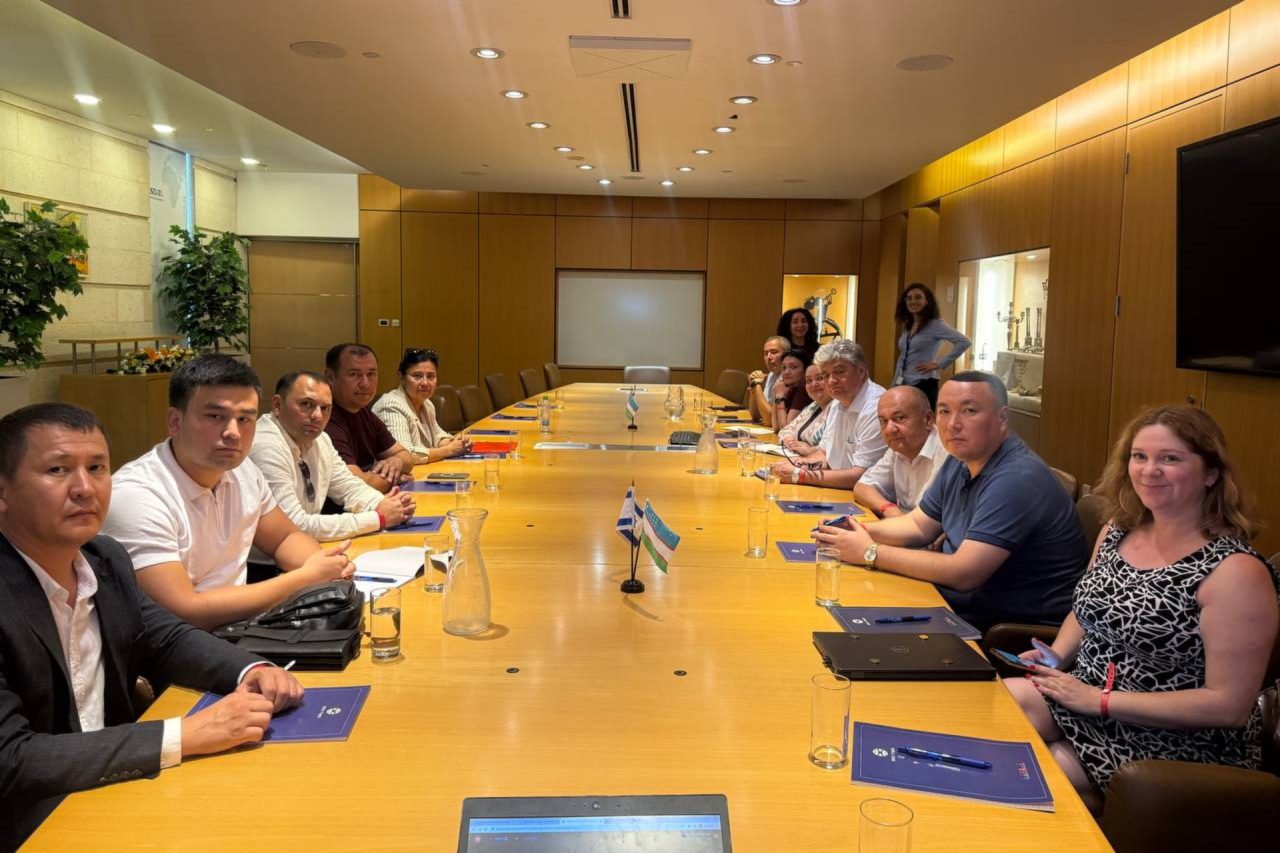
The Uzbek delegation was welcomed by Reut Shafir Ben Naftali, Director of the Department of Central Asia and the Caucasus at the Ministry of Foreign Affairs of Israel. During the meeting, the department director noted that the friendly relations between Uzbekistan and Israel are developing well. She also shared that her most recent trip to Tashkent had left her with wonderful and memorable impressions.
She said that, as part of the programme, water specialists and scientists from Uzbekistan would have the opportunity to visit leading Israeli government institutions, research institutions and private-sector organisations, meet with experts, and take part in practical discussions.
During the meeting at the ministry, the Uzbek delegation also met with Hila Ingelhard and Rafi Kaspi from the ministry’s Economic Department, as well as Irit Savion, Deputy Director of the MASHAV programme.
During the meeting, Hila Ingelhard, a representative of the Economic Department, highlighted the importance of water for economic development. She noted that Israeli scientists and specialists are continuously conducting research and developing new solutions to address water-related challenges and use water resources more efficiently. At a time when climate change is becoming increasingly severe, water remains one of the top priorities on Israel’s agenda, particularly given the country’s arid and desert regions.
Continuing the meeting, Irit Savion, Deputy Director of MASHAV, provided information about the programme. MASHAV is Israel’s Agency for International Development Cooperation under the Ministry of Foreign Affairs. Its main goal is to support the social, economic and environmental development of other countries by sharing Israel’s development experience, knowledge and modern technologies.
MASHAV was established in 1957–1958, at a time when Israel itself was still a developing country. Today, the agency has become an important international platform for sharing knowledge, experience and practical solutions.
MASHAV is not simply an organisation that provides financial assistance. Its main approach is to share knowledge and experience, strengthen the capacity of local specialists, and prepare them to pass on the knowledge they acquire to others. For this reason, the principle of “training of trainers” receives particular attention within its programmes.
Courses and training programmes are organised both in Israel and in partner countries. In addition, Israeli experts may travel to other countries to provide consultation and practical assistance.
The main areas of MASHAV’s activities include agriculture, water resource management, irrigation technologies, food security, climate change, environmental protection, entrepreneurship and innovation, medicine and public health, education, women’s empowerment, and local community development. Many of these areas are fields in which Israel has accumulated significant experience and achieved practical results.
For example, Israel’s experience in addressing water scarcity and using water resources efficiently is an important part of MASHAV’s programmes. Training sessions are organised for international specialists on drip irrigation in agriculture, water conservation, increasing productivity in arid regions, and the use of modern agricultural technologies. Environmental protection and climate change are also among MASHAV’s priority areas.
Through MASHAV, government officials, specialists, scientists, entrepreneurs and representatives of other sectors from different countries can travel to Israel and participate in short-term international courses. The programmes are designed according to the needs of each partner country.
According to official information, since its establishment, MASHAV has operated in more than 140 countries and contributed to the training of hundreds of thousands of specialists in various fields.
In short, MASHAV can be described as “Israel’s international programme for sharing knowledge and experience.” In other words, Israel shares technologies, experience and methodologies that have been successfully implemented domestically with specialists from other countries and, in some cases, also supports the implementation of projects on the ground. MASHAV’s activities are aligned with the United Nations Sustainable Development Goals.
During the Uzbek delegation’s visit to Israel, particular attention is being paid to studying practical experience in water resource management and the efficient use of water. In the context of water scarcity, climate change and growing population needs, effective water resource management is a strategically important issue not only for Israel but also for Uzbekistan.
At the end of the meeting, members of the Uzbek delegation asked questions of interest to them and received detailed answers. The sides emphasised the importance of further exchanging experience and developing cooperation in water resource management, environmental sustainability and modern technologies.
Feruzbek Sayfullayev