

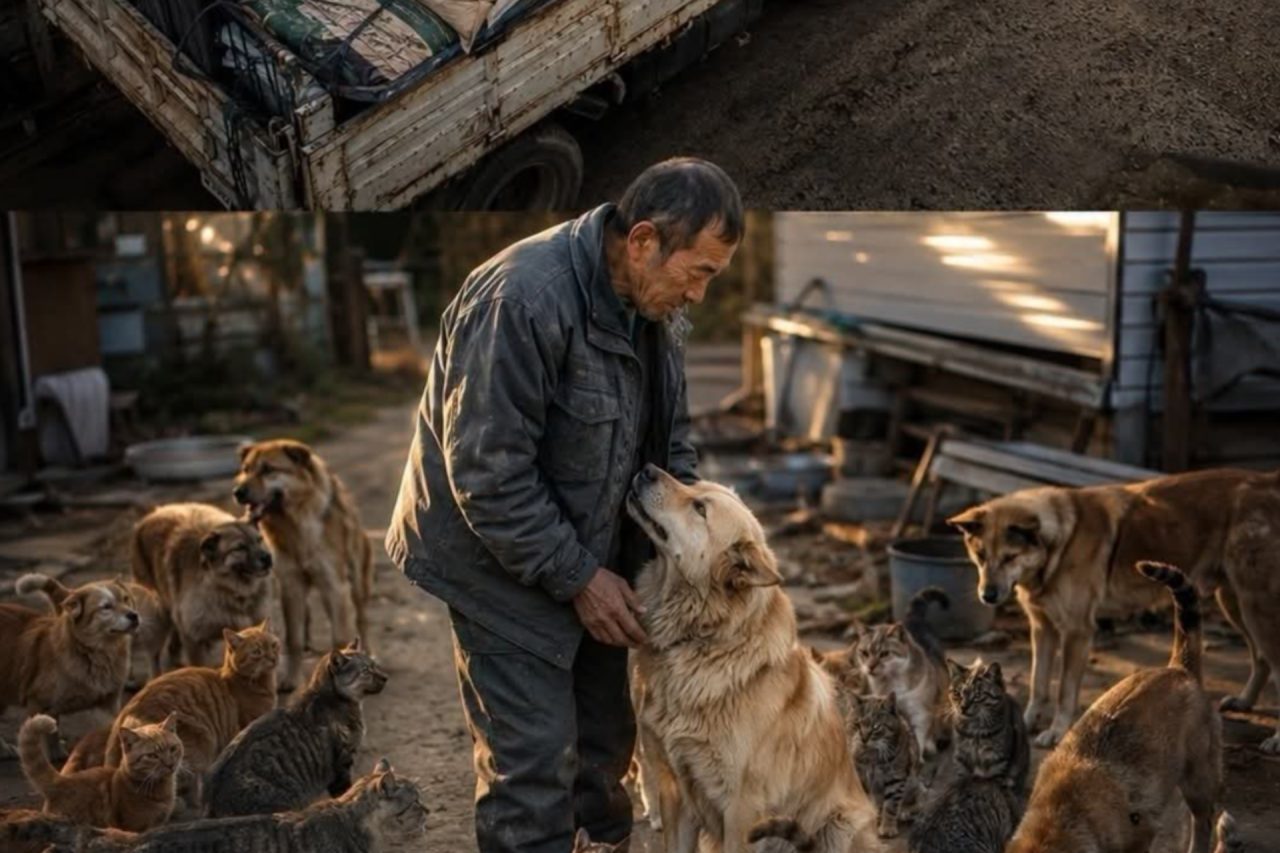
In March 2011, an accident occurred at the Fukushima Daiichi Nuclear Power Plant. The Japanese government ordered the evacuation of all areas within a 20-kilometer radius of the plant. Within a few days, nearly 154,000 people left the exclusion zone. They abandoned their homes, their livestock, and everything they had spent years building. They had to. There was no other choice.
Naoto Matsumura, a 52-year-old farmer, left the area along with everyone else. He reached the home of relatives in a nearby town and spent the night there. But later, he secretly passed through a military checkpoint and returned.
The reason was simple: he could not stop thinking about an iron chain.
His neighbors’ dog had been tied to that chain. The owners had left in a hurry—as everyone did—and the dog had been left behind. No water. No food. Still tied up.
Matsumura returned for that dog.
But when he arrived back in the village, he discovered dozens of dogs in the same situation. Cats were everywhere. Cows remained trapped inside barns, unfed and standing in darkness for days.
He decided to stay.
At first, it was only for a few days—to feed the animals, give them water, and set them free from their chains. Then a few days turned into a few weeks. Eventually, he realized that there was no one else left to help them. The place where he needed to stay became clearer than any place he could go.
Government officials knew about him. Several times they came and told him to leave the exclusion zone. Living there was officially against the law. Yet no one arrested him. I suppose no one had the heart to stop a man who was feeding abandoned animals in a radioactive wasteland.
Every morning, Matsumura loaded animal feed into his old pickup truck and headed out. Cats, dogs, ostriches that had survived on a nearby farm, pigs left hungry in their pens—he brought food for all of them.
He carried a dosimeter. He saw the radiation readings.
And he kept going.
By 2013, Japanese journalists had reached him and produced reports about his life. Soon, the whole world came to know the man who became known as “The Guardian of Fukushima.”
In one interview, he said:
“If I leave, no one will feed them. If not me, then who?”
I sat with those words for a long time.
He understood exactly what radiation was. He knew the risks. Yet he returned for a stranger’s dog that had been left chained behind.
Sometimes it feels as though certain people are made differently from the rest of us. In situations like these, logic alone cannot explain their choices.
Thankfully, people like that exist.
As of 2023, Matsumura was still living alone in the exclusion zone.