

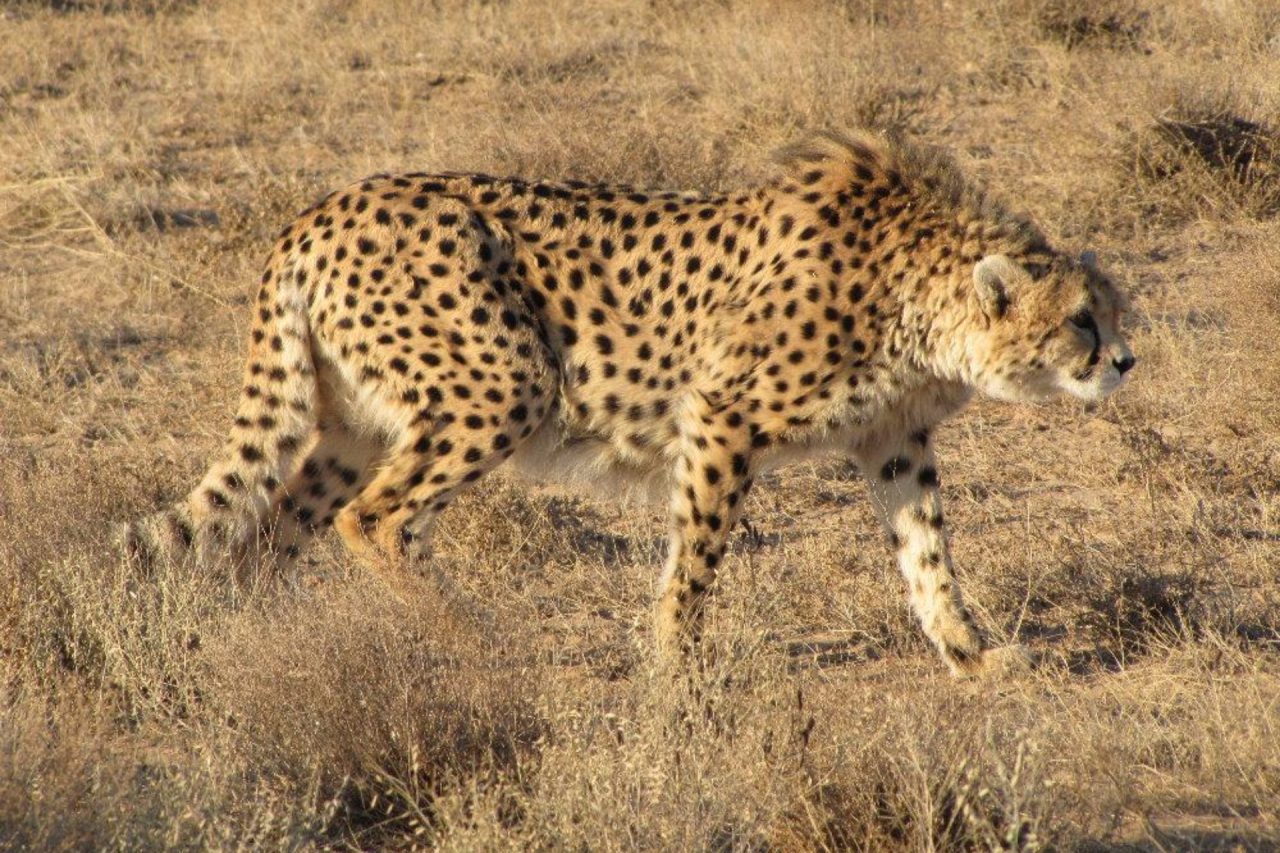
A Rare Predator That Once Inhabited Kyzylkum and Ustyurt
The Asiatic cheetah (Acinonyx jubatus venaticus) is a subspecies of cheetah historically found across parts of Asia. It is distinguished by its long legs, slender body, characteristic black spots and remarkable ability to run at high speeds. Unlike many other large cats, cheetahs primarily catch their prey by pursuing it in high-speed chases.
According to information from Uzbekistan’s Red Data Book published on the EcoEdu environmental education platform, the historical habitats of the Asiatic cheetah in Uzbekistan included the Kyzylkum Desert and the Ustyurt Plateau. The animal disappeared from Kyzylkum as early as the nineteenth century. On the Ustyurt Plateau, 13 individuals were recorded during the 1960s and 1970s, but its presence has not been confirmed since 1973.
These records indicate that the Asiatic cheetah did not disappear from Uzbekistan overnight. Its habitat gradually shrank, and its population declined to such an extent that encounters with the animal in the wild eventually became virtually impossible.
Why Did the Asiatic Cheetah Disappear?
Several factors contributed to the disappearance of the Asiatic cheetah. Information based on Uzbekistan’s Red Data Book identifies the capture and killing of animals, including for captivity, land development and the decline of available prey as major factors behind its population decline.
Illegal hunting and human activity. Uncontrolled hunting, the expansion of economic activities and human encroachment into natural habitats reduced the cheetah’s chances of survival and reproduction.
Declining food sources. The Asiatic cheetah primarily preyed on goitered gazelles, as well as hares, rodents and certain birds. As the populations of these animals declined, finding sufficient food became increasingly difficult, negatively affecting the predator’s survival and reproduction.
Destruction of natural habitats. The development of desert and steppe landscapes, the expansion of human activities and the fragmentation of natural habitats restricted the animals’ ability to move freely.
These factors are closely interconnected and reinforce one another. When a predator’s habitat shrinks, it must travel greater distances to find food. A shortage of prey also reduces its chances of successful reproduction. As a result, an already small population becomes increasingly vulnerable to extinction.
Iran: The Last Refuge of the Asiatic Cheetah
Today, the last known population of the Asiatic cheetah in the wild survives in Iran. According to specialists associated with the International Union for Conservation of Nature (IUCN), the subspecies’ current distribution is largely restricted to the country’s arid regions. Its population is extremely small, and the risk of extinction remains high.
The Touran Biosphere Reserve in Iran is one of the most important areas for the conservation of the Asiatic cheetah. Camera traps are used there to detect individual animals and assess their population.
According to a monitoring report published by the Iranian Cheetah Society covering the period from 2021 to 2023, 26 individual cheetahs were recorded during surveys in the Touran and Miandasht areas. They included seven females, three males and 16 cubs. Up to 90 camera traps were used in certain years, and more than 800,000 images were collected over the three-year period.
However, the 26 recorded animals should not be interpreted as an exact estimate of the total Asiatic cheetah population in Iran. The figure represents individuals documented in specific areas over a defined period. Nevertheless, the monitoring results demonstrate just how rare the subspecies has become and why protecting every individual is crucial.
What Can Be Done to Save the Species?
Protecting the Asiatic cheetah requires more than simply banning hunting. Its natural habitats must be preserved, its prey populations protected, water sources maintained and scientific monitoring conducted regularly.
According to information from the Netherlands office of IUCN, various measures have been implemented in the Touran region of Iran to improve conditions for cheetahs. These include restricting livestock grazing in certain important areas, improving access to water sources and strengthening the management of protected areas.
Excessive livestock grazing can damage vegetation and negatively affect populations of animals that serve as prey for cheetahs, including goitered gazelles.
This experience is also relevant to Uzbekistan. Protecting rare species requires assessing the condition of natural ecosystems, preserving biodiversity in their historical habitats, protecting prey species such as goitered gazelles and developing environmental monitoring programmes.
Is It Possible to Bring Back an Extinct Local Population?
Restoring a species to an area where it has disappeared is a complex and long-term undertaking. Before any reintroduction programme can begin, scientists must assess the condition of the ecosystem, the availability of prey and water, and whether animals would be able to move safely through the landscape.
The origin of the animals, their genetic characteristics and their ability to adapt to new environmental conditions must also be considered.
However, without reliable evidence of an active project or an officially approved plan to reintroduce the Asiatic cheetah to Uzbekistan, it would be inaccurate to claim that such a programme is already underway or will be implemented in the near future.
For now, the most important priority is to protect the rare species that still inhabit Uzbekistan and preserve their natural habitats before further losses occur.
Protecting Nature Is a Responsibility to Future Generations
The story of the Asiatic cheetah demonstrates the consequences of disrupting the balance between humans and nature. Once roaming Uzbekistan’s vast landscapes, this predator can no longer be found in the country’s wild habitats. Its disappearance represents not only the loss of an animal species but also the loss of an important part of our natural heritage.
Every species plays a specific role in its ecosystem. Protecting endangered animals, preserving natural habitats, combating illegal hunting and raising environmental awareness are therefore shared responsibilities.
The tragic fate of the Asiatic cheetah reminds us of an important truth: if we fail to protect nature today, tomorrow we may be able to see its extraordinary inhabitants only in photographs.
Nature is an invaluable legacy that we must preserve for future generations. Protecting it is one of the most.