

The issues of cooperation between countries, the rational use of natural resources and ensuring environmental security are particularly important in Central Asia, where the consequences of climate change are becoming increasingly severe.
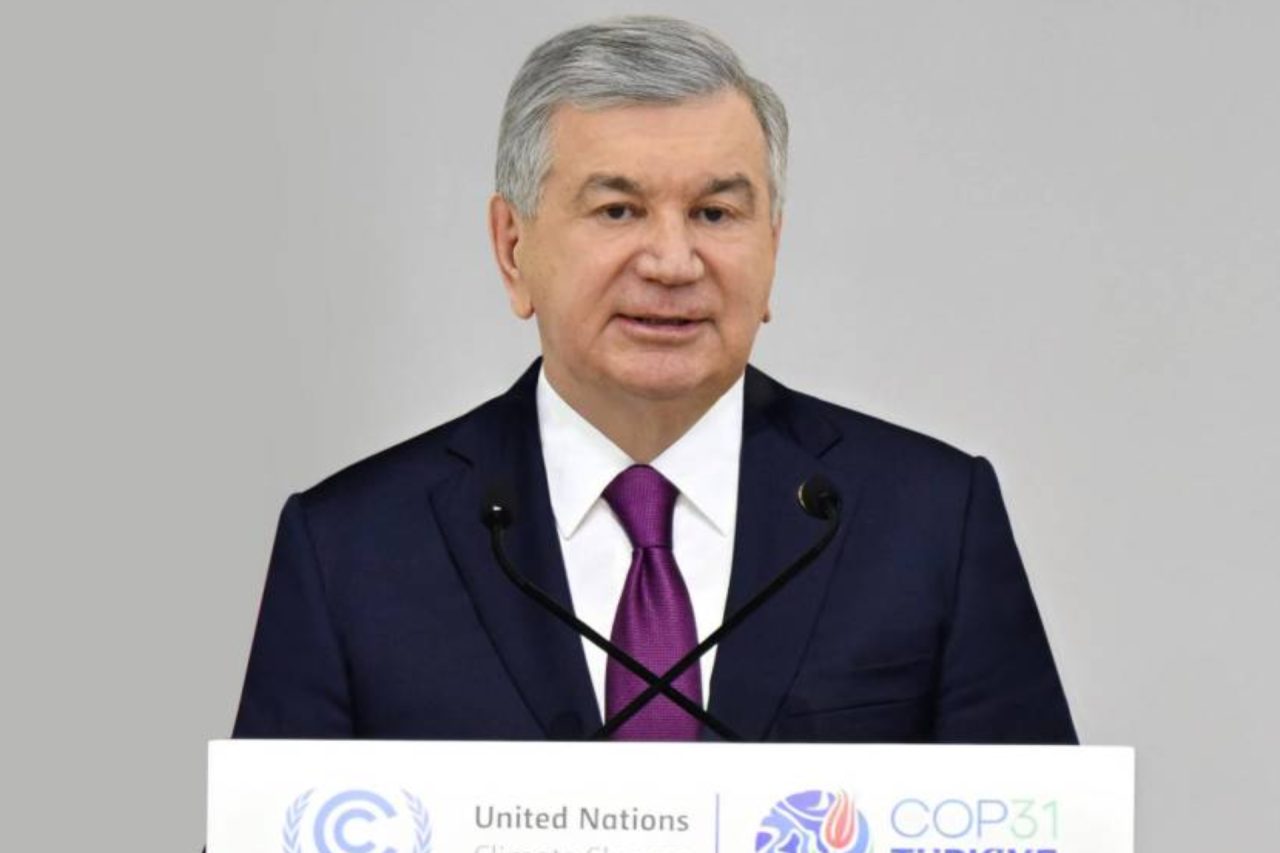
In his speech at the 31st Session of the UN Climate Change Conference (COP31), President of the Republic of Uzbekistan Shavkat Mirziyoyev outlined the country's priorities in addressing climate change, highlighted the progress achieved and presented initiatives aimed at strengthening international cooperation.
The initiative put forward by the President to develop a Central Asian Climate Integration Model could become an important step towards strengthening regional solidarity, facilitating the exchange of information on climate risks, introducing modern environmental technologies and establishing sustainable financing mechanisms.
The full text of the President's speech is available below.
Speech by the President of the Republic of Uzbekistan Shavkat Mirziyoyev at the 31st Session of the UN Climate Change Conference
Your Excellency President Recep Tayyip Erdoğan!
Distinguished Heads of State and Government!
Mr. President of the Conference!
Ladies and Gentlemen!
First of all, I would like to express my sincere gratitude to the President of the Republic of Türkiye, my dear brother, His Excellency Recep Tayyip Erdoğan, for the traditional hospitality extended to us in Antalya, the pearl of the Mediterranean.
I would also like to particularly acknowledge the high level of preparation for this conference under the co-presidency of Türkiye and Australia.
Uzbekistan has consistently supported global efforts to combat climate change. We are building a new development model based on green technologies and the rational use of natural resources. We are rapidly reducing the carbon intensity of our economic sectors.
Our country has achieved ahead of schedule its target of reducing greenhouse gas emissions per unit of gross domestic product by 35 per cent.
We have set a new target of reducing harmful emissions by 50 per cent by 2035.
Restoring the disrupted balance between development and the laws of nature requires a steady increase in the share of green energy. Over the next four years, the share of renewable energy sources in Uzbekistan will reach 54 per cent.
We have also set clear commitments to the rational use of water resources. Our efforts in this area are already producing positive results. Over the past ten years, water consumption in our economy has almost halved, while the volume of water withdrawn from river basins has decreased by one-fifth. Water-saving technologies have been introduced on 60 per cent of irrigated land.
Starting next year, Uzbekistan will chair the International Fund for Saving the Aral Sea. We are ready to fulfil this important responsibility, including the effective management of transboundary river basins.
At the same time, we are implementing large-scale land restoration initiatives. The area of forests in our country has increased to six million hectares, with one-third of this area located in the Aral Sea region.
In addition, we have launched the Strategy for Waste Management, which will attract more than three billion US dollars in investment.
Youth issues occupy a central place in Uzbekistan's state policy. As the Uzbek proverb says: "If you want to harvest fruit from a tree, take care of it from the time it is a sapling."
In our country, environmental education for children is organised through the coordinated efforts of families, mahallas and schools. From an early age, children are taught to conserve water, care for trees and maintain cleanliness and order in their surroundings.
Every fifth citizen of our country is a school pupil or university student. Thanks to systematic environmental education, by 2050, three-quarters of Uzbekistan's population will have a solid understanding of nature conservation.
Dear Friends!
No country can solve climate challenges alone.
In Central Asia, threats such as melting glaciers, water scarcity and droughts are becoming increasingly severe. These shared challenges require joint action by the countries of our region.
In this regard, we are putting forward an initiative to develop a Central Asian Climate Integration Model. We propose launching this cooperation in three key areas.
The first is the information-sharing dimension.
In this area, it is essential to establish an infrastructure for exchanging information on climate risks with the support of the World Meteorological Organization.
At the initial stage, it would be appropriate to establish an early warning system to enable prompt responses during natural disasters.
The next important step should be to develop indicators for monitoring slow-onset natural disasters and establish joint mechanisms based on these indicators.
The second is the technological dimension.
Green technologies can help restore soils, absorb carbon in arid regions, and combat dust and sandstorms.
Every year, we organise the Central Asian Eco-Expo, where we share best practices and promising innovations.
Our goal is to transform this exhibition into a permanent platform for investment and technology, offering modern environmental solutions tailored to the specific conditions of our region.
The third is the financial dimension.
Central Asia needs sustainable sources of financing that take into account local conditions and needs.
In this regard, we propose developing new support instruments jointly with development banks, including concessional grants, as well as blue and arid financing mechanisms.
Distinguished Heads of Delegations!
We call upon all countries and international organisations participating in this conference to give practical substance to the Climate Integration Model.
We propose extending this viable model to other regions interested in such cooperation.
Creating a prosperous life and favourable conditions for future generations, and protecting our planet, is a shared human responsibility.