

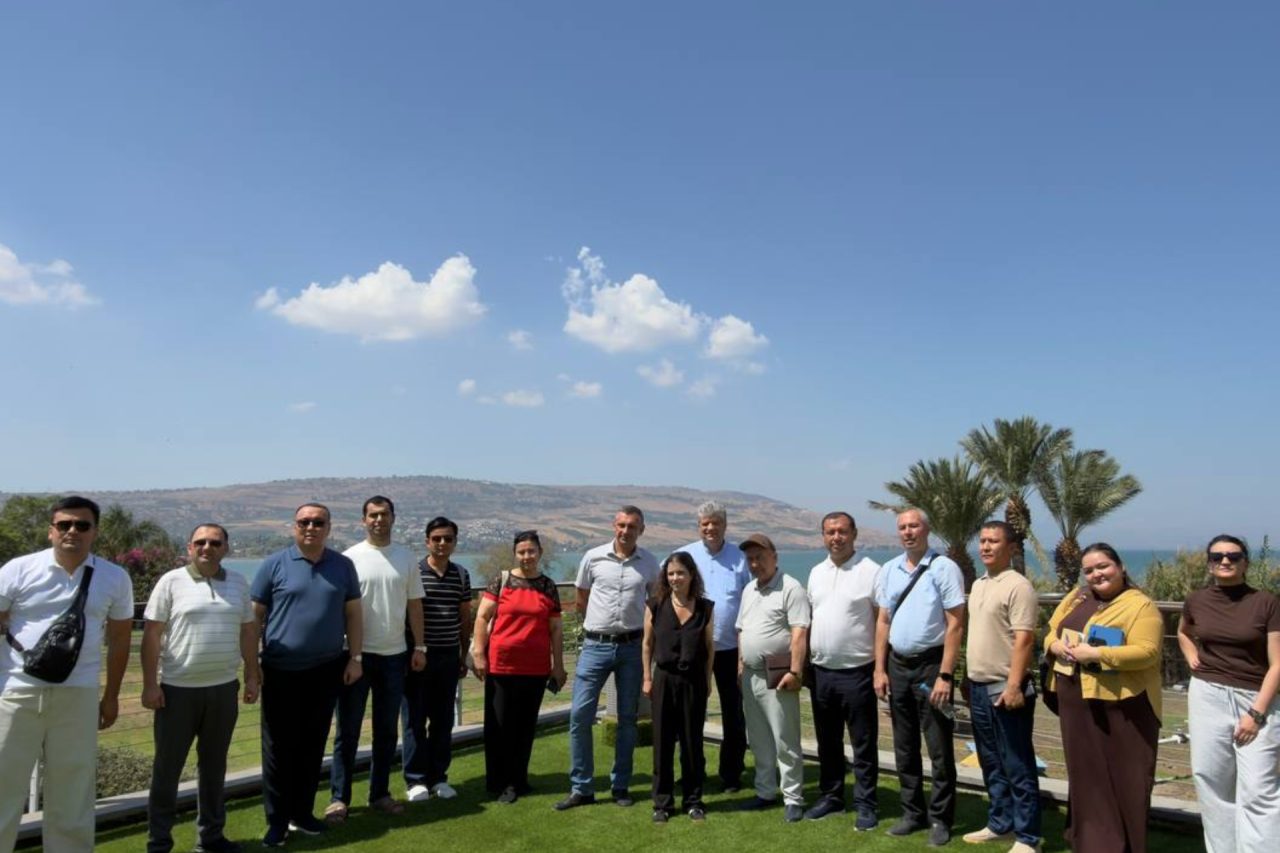
Kinneret Academic College is located in northern Israel, on the shores of Lake Kinneret — a body of water of vital importance to the country and more commonly known to us as the Sea of Galilee. The college was established in 1965 and today provides undergraduate and graduate education in a range of fields.
The college’s location also gives its activities a distinctive context. Lake Kinneret plays an important role in Israel’s water resource system. The college itself describes the surrounding area as an academic environment closely connected with water resources, agriculture, innovation and sustainable development.
According to the information provided by the college specialists who welcomed our group, the institution is one of Israel’s specialised educational centres for training engineers for the water industry. Students study such areas as water and wastewater treatment, water desalination, water quality, hydrology, sustainability and environmental risk management. Fundamental subjects such as physics, chemistry, microbiology and fluid mechanics also play an important role in the curriculum.
In many ways, this also reflects Israel’s approach to addressing water-related challenges. In a country facing water scarcity, water is not viewed solely as the responsibility of government agencies or municipal services. Instead, it is treated as a strategic field that brings together science, technology, business and education.
Combining Theory with Practice
Kinneret Academic College places strong emphasis on practical experience as part of the educational process. Within the water engineering programme, students connect their academic knowledge with practice through modern laboratories, computer modelling, engineering simulations and field research.
The college also works closely with companies in the water industry. This aspect is particularly interesting. Students do not only acquire theoretical knowledge in the classroom; they also learn how to work with real-world challenges they may encounter in their future careers. According to the college’s official information, the institution maintains relationships with more than 100 partner employers, and 90% of its graduates find employment in industry.
This approach is particularly important for the water sector. Addressing water-related challenges requires not only theoretical knowledge, but also the ability to apply engineering solutions in real-world conditions, select appropriate technologies and use available resources efficiently.
Water, Ecology and Sustainable Development as an Integrated System
The college’s activities are not limited to water engineering. Its areas of international cooperation include water resource management, sustainable agriculture, climate change adaptation, sustainable development and technological innovation.
The college’s international cooperation centre works on projects aimed at turning environmental challenges into practical and innovative solutions. It focuses on knowledge exchange, professional development and applied research related to water, climate change, agriculture and sustainable development.
This experience may also be highly relevant to Uzbekistan. Issues such as the rational use of water resources, the introduction of water-saving technologies in agriculture, adaptation to climate change and finding innovative solutions to environmental challenges are becoming increasingly important for our country.
The College’s Location as a Kind of Open Laboratory
Another distinctive feature of the college is its location. The campus is situated directly on the shores of Lake Kinneret. The surrounding area includes kibbutzim, agricultural lands, tourist destinations and historical sites.
As a result, the students’ educational environment extends beyond the classroom. Nature, water resources, agriculture and the history of the region also become part of the learning experience. Alongside engineering, the college offers social sciences, humanities, management, tourism and Israeli history.
This makes the college not only an institution for training specialists, but also a unique academic environment where students can study the region’s natural and social surroundings.
What Can Uzbekistan Learn from This Experience?
Training water engineers in a region facing water challenges; studying water, ecology, agriculture and climate change as interconnected issues; involving students in laboratory and field practice; and cooperating with businesses and industry — all of these approaches increase the practical value of education.
Today, as environmental challenges become increasingly complex, it is no longer enough to train only environmental specialists or engineers. We need engineers who understand water resources, economists who understand environmental issues, agricultural specialists who understand climate change, and young professionals capable of turning innovation into practical solutions.
The experience of Kinneret Academic College demonstrates that water cannot be viewed solely as a water-related issue. Water is part of a much broader system that connects ecology, agriculture, the economy, technology, education and the future. Learning about this integrated approach during the visit of Uzbek specialists to Israel is therefore important for strengthening knowledge and experience exchange between the two countries.
Feruzbek Sayfullayev