

The Dead Sea is remarkable not only for its high salinity but also for its geographical location. Its shores lie in one of the lowest exposed land areas on Earth, approximately 430–440 metres below sea level. However, its water level is not constant and has been gradually declining over the years.
Why is it so difficult to sink in the Dead Sea?
The water in the Dead Sea is several times saltier than ordinary seawater. While the average salinity of the world's oceans is around 3.5%, the salinity of the Dead Sea can exceed 30%.
This is largely due to the lake's geographical and climatic conditions. The Jordan River and several seasonal streams flow into the Dead Sea, but its water has no outlet to other seas or oceans. Because the region has a hot and dry climate, large amounts of water evaporate, while dissolved salts and minerals remain behind. Over time, this process increases the concentration of salt in the lake.
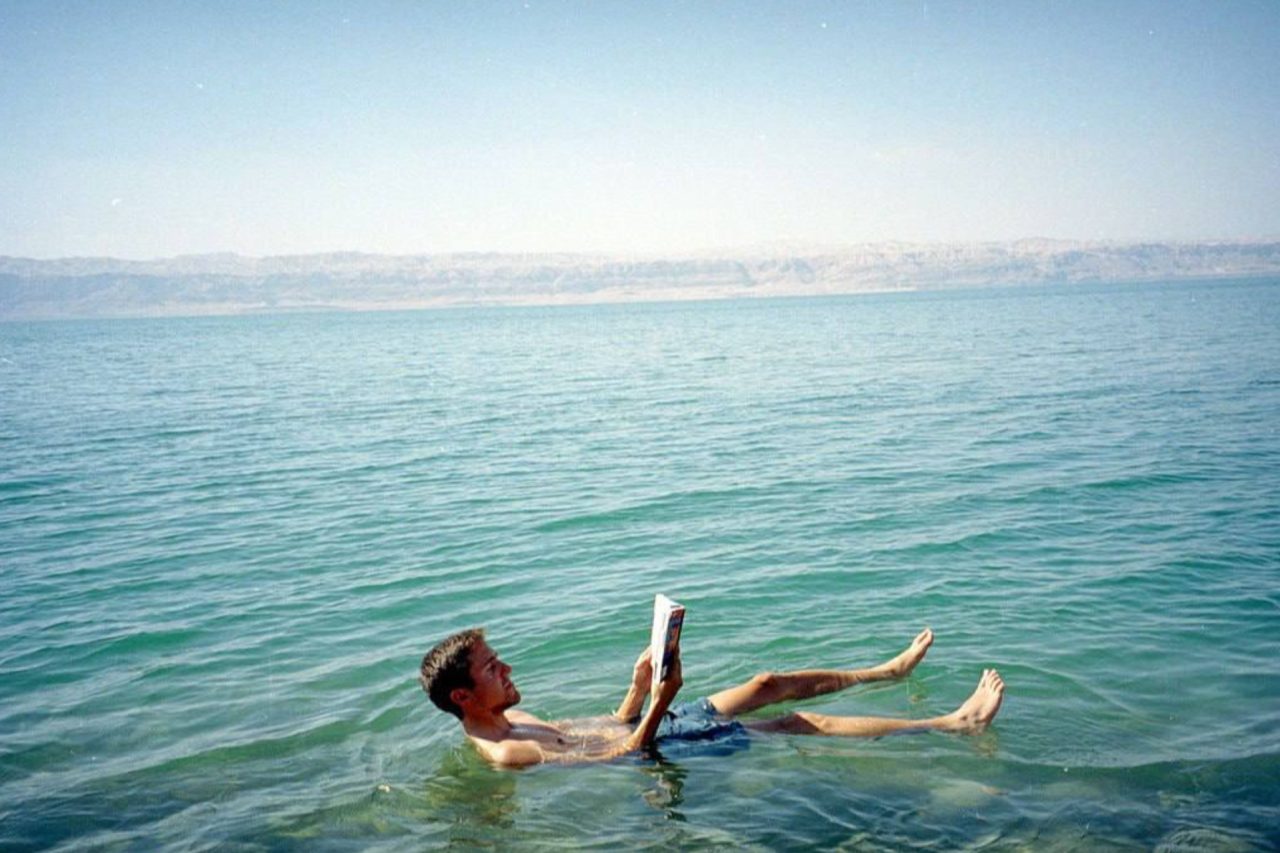
The high concentration of salts and minerals makes the water much denser than ordinary seawater. As a result, it provides greater buoyancy, allowing the human body to float more easily. Visitors can often lie on the water's surface without actively moving their arms or legs.
However, it is incorrect to assume that drowning in the Dead Sea is impossible. Falling face-down into the water or accidentally swallowing it can be dangerous. Therefore, visitors should follow safety precautions when swimming. Getting the highly concentrated water into the eyes or open wounds can also cause intense irritation and pain.
Why is it called the Dead Sea?
The lake's name is connected to its unusual natural conditions. Because of its extremely high salt and mineral content, most familiar aquatic organisms, including fish and many types of aquatic plants, cannot survive in its waters.
Nevertheless, this does not mean that the Dead Sea is completely lifeless. Scientists have discovered microorganisms, including certain bacteria and archaea, that can adapt to extremely salty environments. Microscopic algae may also develop under specific conditions.
Therefore, the name "Dead Sea" does not mean that absolutely no living organisms exist there. Rather, it reflects the fact that a typical aquatic ecosystem is almost entirely absent.
Where is the Dead Sea located?
The Dead Sea is located in the Middle East, between Jordan, Israel and the West Bank. It lies in the deepest part of the Jordan Valley, within a geological rift zone associated with the movement of the African and Arabian tectonic plates.
The lake is approximately 76 kilometres long and reaches a width of around 18 kilometres in some places. Its northern section is considerably deeper than the southern part, with the maximum depth exceeding 300 metres.
The surrounding landscape is characterised by an arid climate, rocky mountains, salt-covered shores and unusual mineral formations.
The region is important not only for its natural features but also for its historical and cultural significance. The Dead Sea and its surroundings are mentioned in various historical and religious sources. In addition, the nearby Qumran Caves became famous after the discovery of the Dead Sea Scrolls, which are of great importance to the study of ancient history and religion.
Why is the Dead Sea shrinking?
One of the most serious environmental challenges facing the Dead Sea today is its declining water level. Over recent decades, the amount of water flowing into the lake has decreased significantly. One of the main reasons is the extensive use of water from the Jordan River and its tributaries for agriculture, industry and household needs.
The region's hot and dry climate also contributes to the problem by accelerating evaporation. As a result, the water level continues to fall, and the shoreline is gradually retreating.
This process has serious environmental and geological consequences. In particular, sinkholes have appeared in areas surrounding the Dead Sea. These form when underground salt deposits dissolve after being exposed to freshwater, causing the ground above them to lose stability and collapse.
Such sinkholes can pose risks to roads, buildings, tourist facilities and other infrastructure near the shoreline. For this reason, scientists continue to monitor changes in the lake's water level and the geological processes taking place in the region.
A unique natural phenomenon
The Dead Sea remains one of the most extraordinary natural features on Earth. Its exceptionally salty water, the ability to keep the human body afloat and its location in one of the lowest exposed land areas make it truly unique.
Its unusual environment, geological structure and ancient history continue to attract scientists and tourists from around the world.
However, even such a remarkable natural site is not immune to environmental change. The declining water level and the gradual transformation of the surrounding landscape raise serious questions about the future of the Dead Sea and the need to protect this unique natural heritage.